10-11世纪印度那烂陀寺石雕释迦牟尼佛与二菩萨(纽约大都会博物馆)
尺寸:H. 26 1/4 in. (66.7 cm); W. 17 3/8 in. (4.1 cm); D. 8 1/8 in. (20.6 cm)
年代:10-11世纪
质地:黑片岩(Black schist)
风格:印度 那烂陀寺
来源:纽约大都会博物馆
参阅:外部链接
鉴赏:

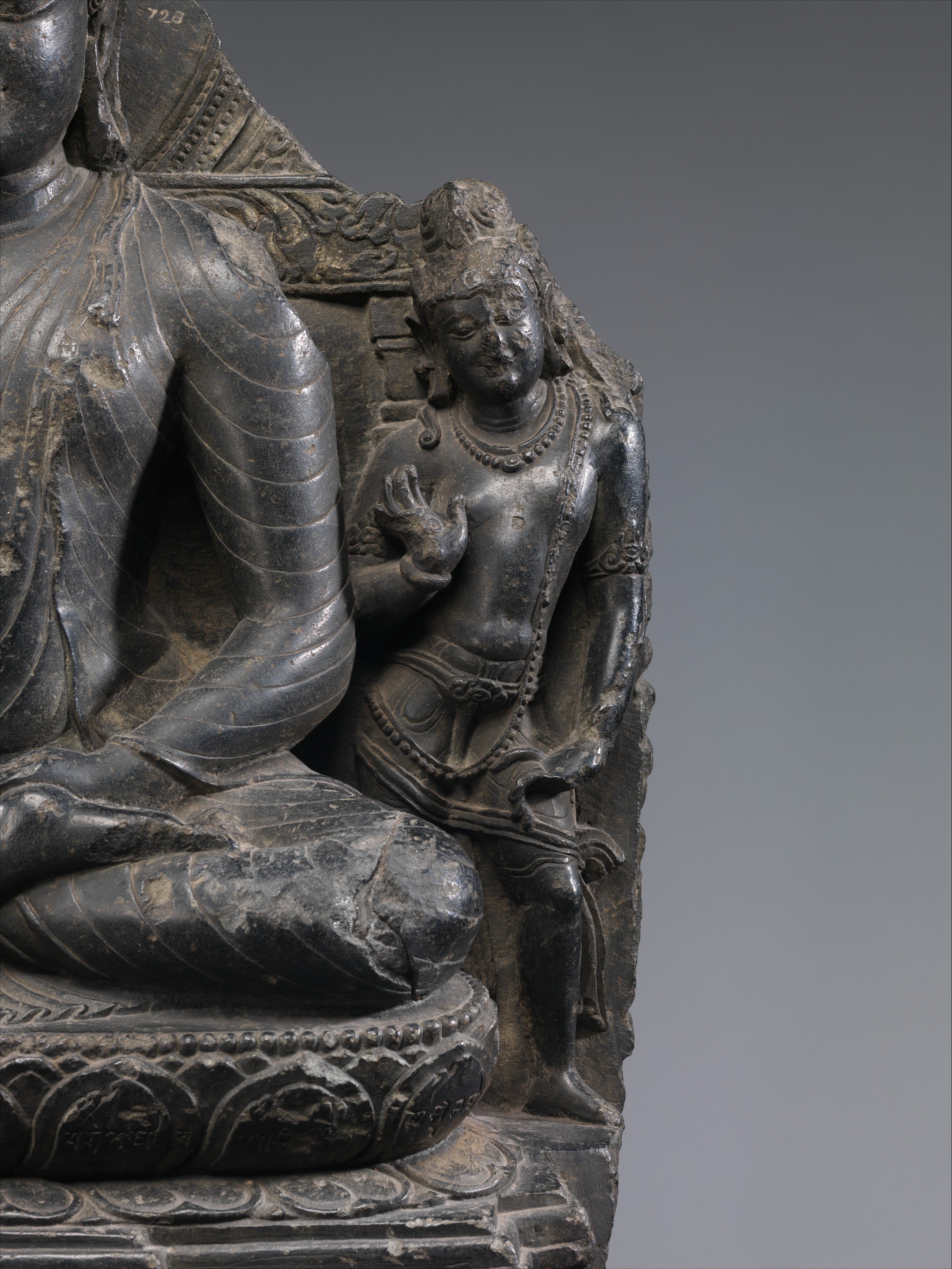
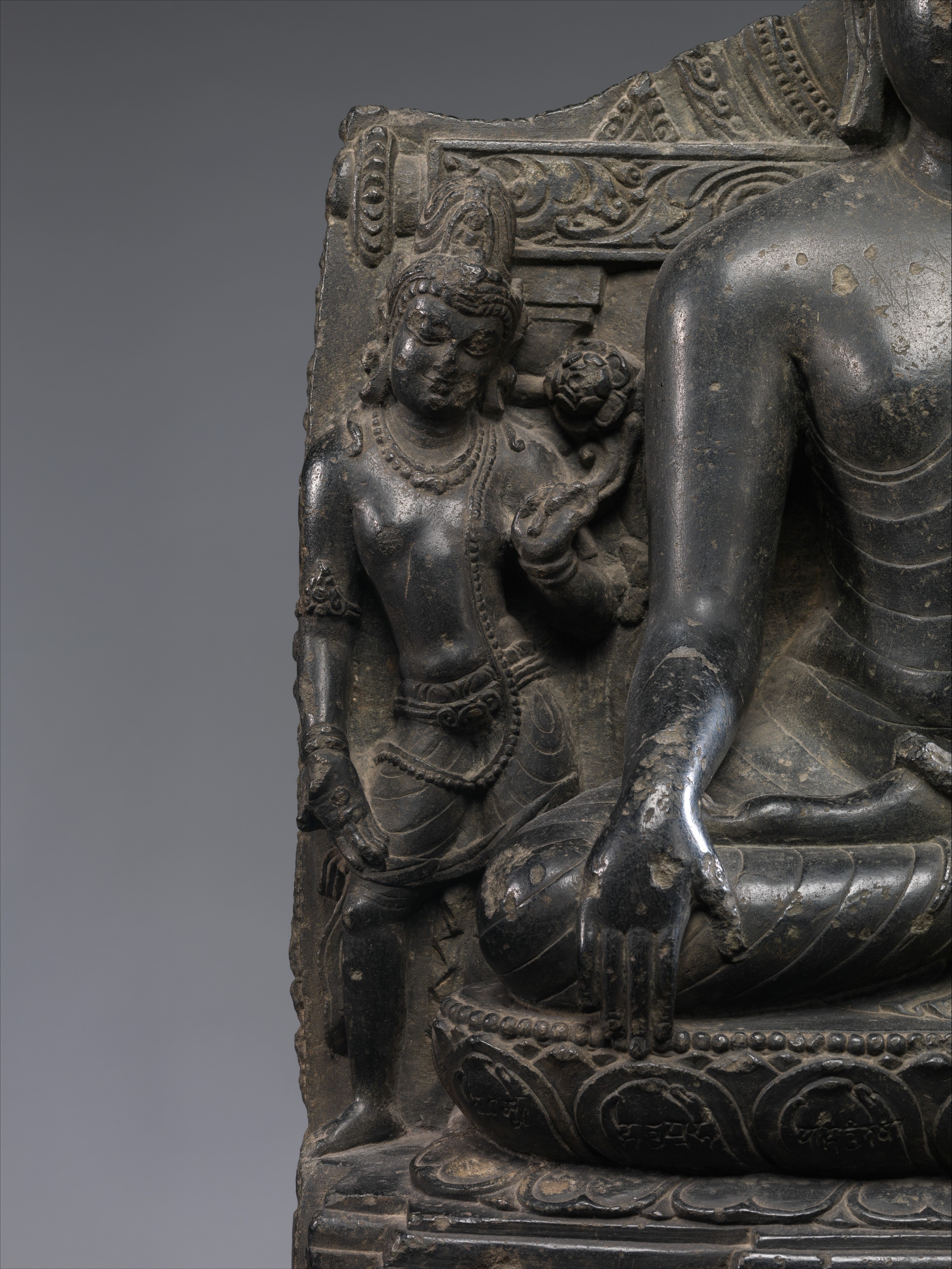
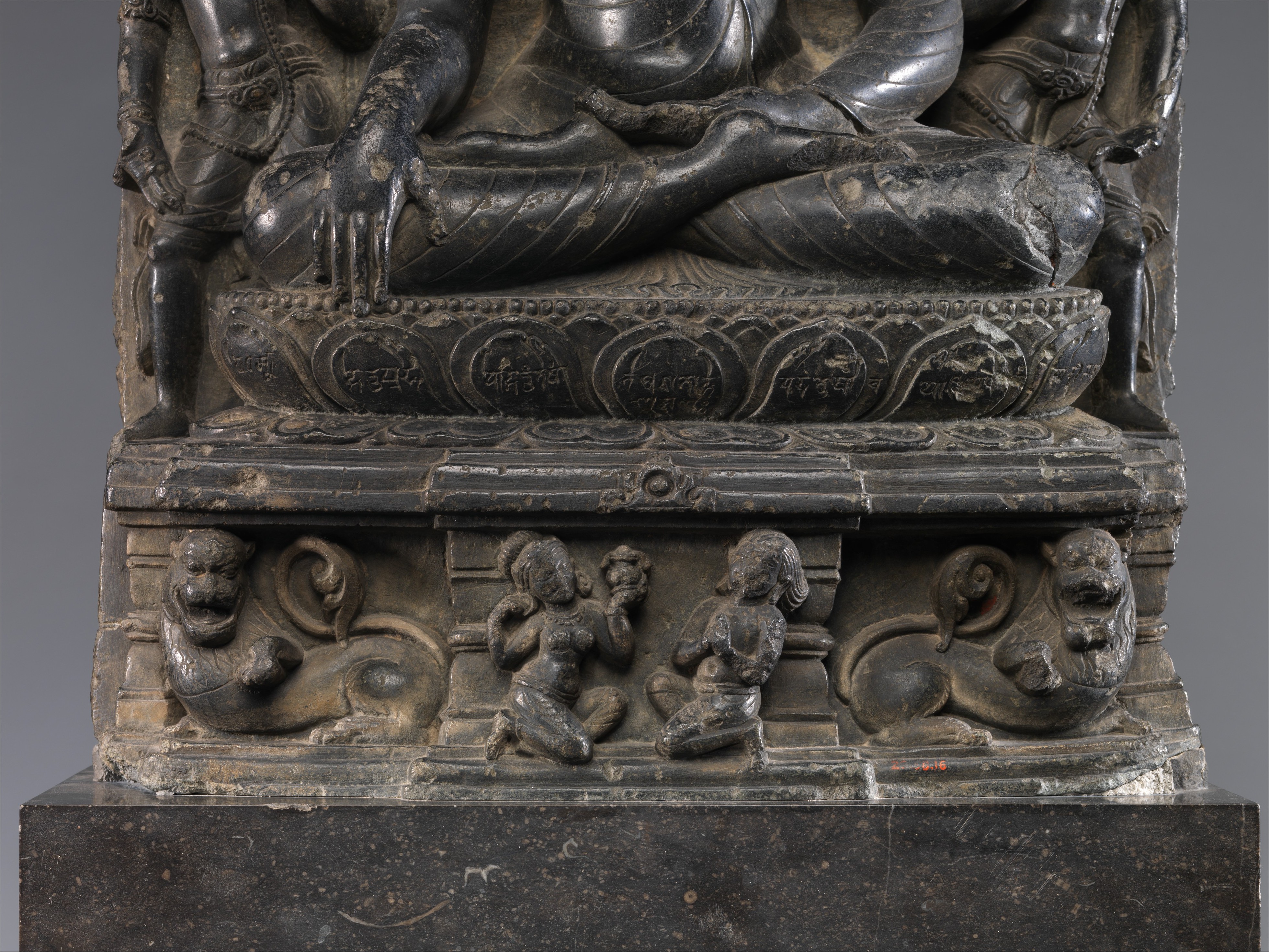 释迦牟尼佛与观音菩萨和弥勒菩萨
Seated Buddha Reaching Enlightenment, Flanked by Avalokiteshvara and Maitreya
late 10th–11th century
India, Bihar, Nalanda monastery
This Buddha from the great monastic site of Nalanda is seen at the moment of enlightenment, with his right hand reaching down to touch the earth, bearing witness to his past refined and meritorious actions, including those in countless past lives that brought him to this point of ultimate realization. The Buddha sits in a yogic posture, deep in meditation. His enlightenment allowed him not only to realize, but also to teach, the Four Noble Truths, as stated in the inscription on his lotus throne:
Of all dispositions proceeding from a cause The Tathagata [Buddha] has explained the cause And he has explained their cessation also This is the doctrine of the great Shramana [the great ascetic or meditator—the Buddha].
At his right stands the bodhisattva Avalokiteshvara, identifiable by the image of the Buddha Amitabha in his headdress. At his left is Maitreya, the next Buddha who will come in some distant future.
铭文:
Inscription: (On lotus throne) Ye dharmma hetuprabhava hetum tesham tathagato hyavadatteshan (cha) ye (nirodha evam) vadi mahasramanah. (trans: Of all dispositions proceeding from a cause, the Tathagata [i.e. the Buddha] has explained the cause and he has explained their cessation also. This is the doctrine of the great Samana (the Buddha). Inscription read by C.R.R. Chowdhury of the Asutosh Museum, Calcutta (see letter from D.P. Ghosh, 3/7/60 in R.E. Dept. files).
Note: the characters of the inscription are Proto-Bengali of th late 11th century A.D. The language is Sanskrit.
来源:
[Paul Mallon , Paris, until 1920; sold to MMA]
著录:
Goloubew, Victor. “Quatorze sculptures indiennes de la collection Paul Mallon, decrites par Victor Goloubew.” Rūpam, no. 2, April 1920. pp. 21–23.
Mallon, Paul, and Victor Goloubew. Quatorze Sculptures Indiennes de la Collection Paul Mallon. Paris: s.n., [1920?], pl. 8.
Zimmer, Heinrich. The Art of Indian Asia: its Mythology and Transformations. Edited by Joseph Campbell. Bollingen 39. New York: Pantheon Books, 1955, vol. 1, 175, vol. 2, pl. 380.
Lippe, Aschwin. “The Sculpture of Greater India.” The Metropolitan Museum of Art Bulletin, n.s., 18, no. 6 (February 1960). pp. 186–87.
Enamul Haque. “The Pala Patrimony in the Metropolitan Museum of Art.” Orientations, 25, no. 3, March 1994. p. 55, fig. 3.
Paul, Debjani. The Art of Nālandā: Development of Buddhist Sculpture, AD 600–1200. New Delhi: Munshiram Manoharlal Publishers, 1995, pl. 39.
Behrendt, Kurt. “Tibet and India: Buddhist Traditions and Transformations.” The Metropolitan Museum of Art Bulletin 71, no. 1 (Winter 2014). p. 11, fig. 6.