11世纪印度帕拉石雕释迦牟尼佛说法像(纽约大都会博物馆)
尺寸:H. (without base) 24 1/4 in. (61.6 cm); W. 20 in. (50.8 cm); D. 8 in. (20.3 cm)
年代:11世纪
质地:黑石雕
风格:帕拉(可能来自那烂陀寺)
来源:纽约大都会博物馆
参阅:外部链接
鉴赏:

 Buddha Preaching the First Sermon at Sarnath
India (Bihar, probably Nalanda)
11th century
On view at The Met Fifth Avenue in Gallery 238
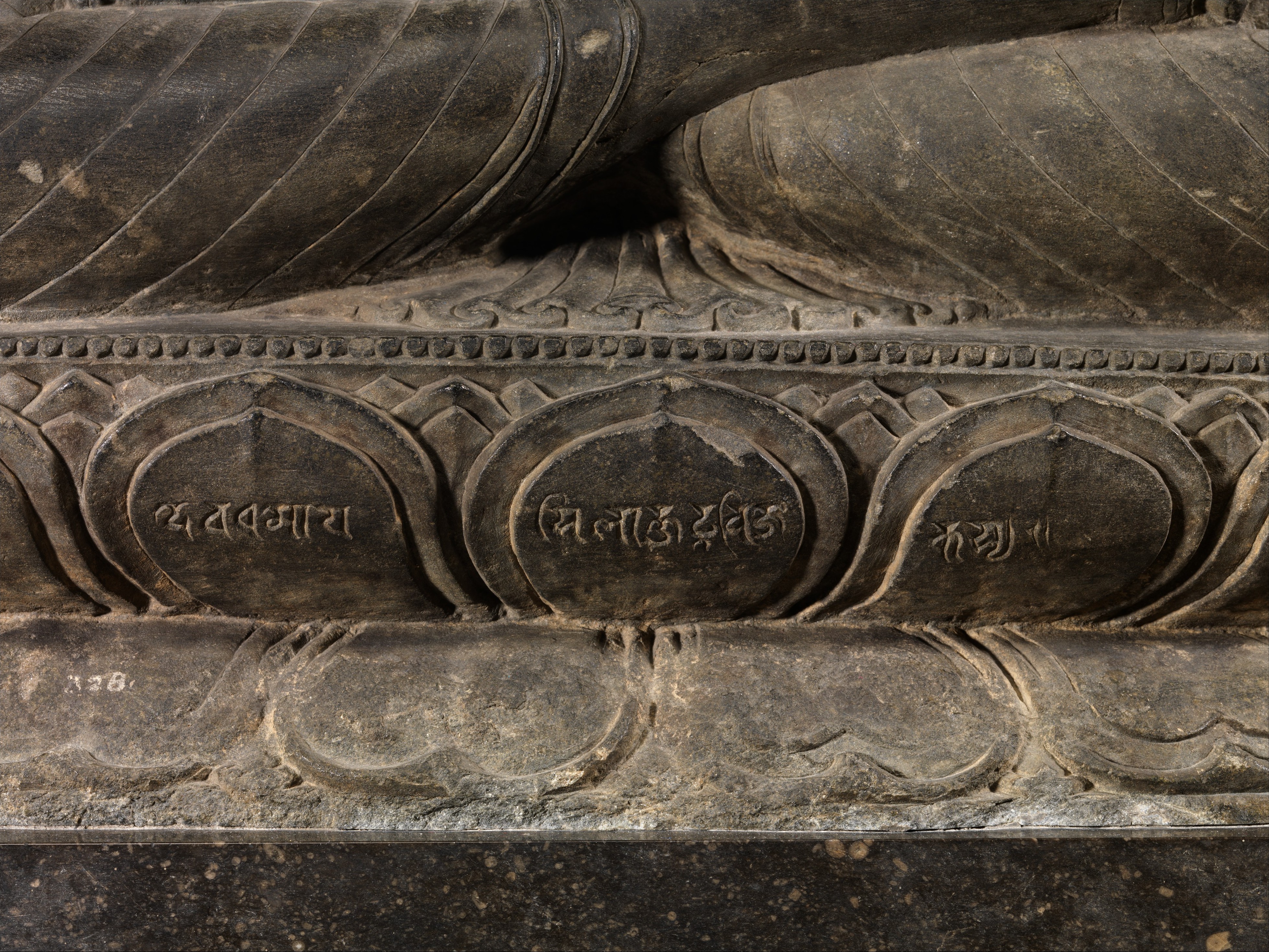
A popular subject in medieval Buddhist art is the Buddha preaching his first sermon in a deer forest at Sarnath, north of Bodhgaya, where he had experienced enlightenment some weeks prior. He is seated in a full yogic position with his monastic robe drawn over both shoulders and his raised hand gesturing the turning of the wheel of Buddhist law, or dharma (dharmacakra mudra). A Sanskrit inscription in proto-Bengali script on the lotus-throne base can be read as, “To the cause of the divine religion [by] the stonecutter [sculptor] Vijaka.” This is a rare instance of a Pala-dynasty sculptor being named.
铭文:
Inscription: (On lotus throne): Devadha ® maya/ silakutta Vija/kasya (trans: To the cause of the divine religion [i.e. the Buddhism] [by] the stone-cutter Vijaka. Inscription read by C.R.R. Chowdhury of the Asutosh Museum, Calcutta; see letter from D.P. Ghosh in F.E. Dept's files, 3/7/60).
Note:
The characters of the inscription are Proto-Bengali of the late 11th century A.D. The language is Sanskrit with only two mistakes, one in “sya” for “kena” in case ending of the donor's name; another is the use of “s” in the word “sila”. The subscript of Devadha ® maya, however, is absent. Though unusual, the expression Davadha ® maya appears to refer to Buddhism.
来源:
[ Paul Mallon , Paris, until 1920; sold to MMA]
著录:
Mallon, Paul, and Victor Goloubew. Quatorze Sculptures Indiennes de la Collection Paul Mallon. Paris: s.n., [1920?], pl. 9.
Mitra, Debala. “A Frieze from Goli in The Metropolitan Museum of Art, New York.” Journal of the Asiatic Society (1961).
Behrendt, Kurt. “Tibet and India: Buddhist Traditions and Transformations.” The Metropolitan Museum of Art Bulletin 71, no. 1 (Winter 2014). p. 8, fig. 4.