
侧边栏

14世纪西藏或尼泊尔铜鎏金佛首(香港邦瀚斯)
尺寸:高40.5 cm
年代:14世纪
质地:铜鎏金
风格:西藏或尼泊尔
来源:拍卖会
成交:575,500港元(2025.10)
参阅:外部链接
鉴赏:
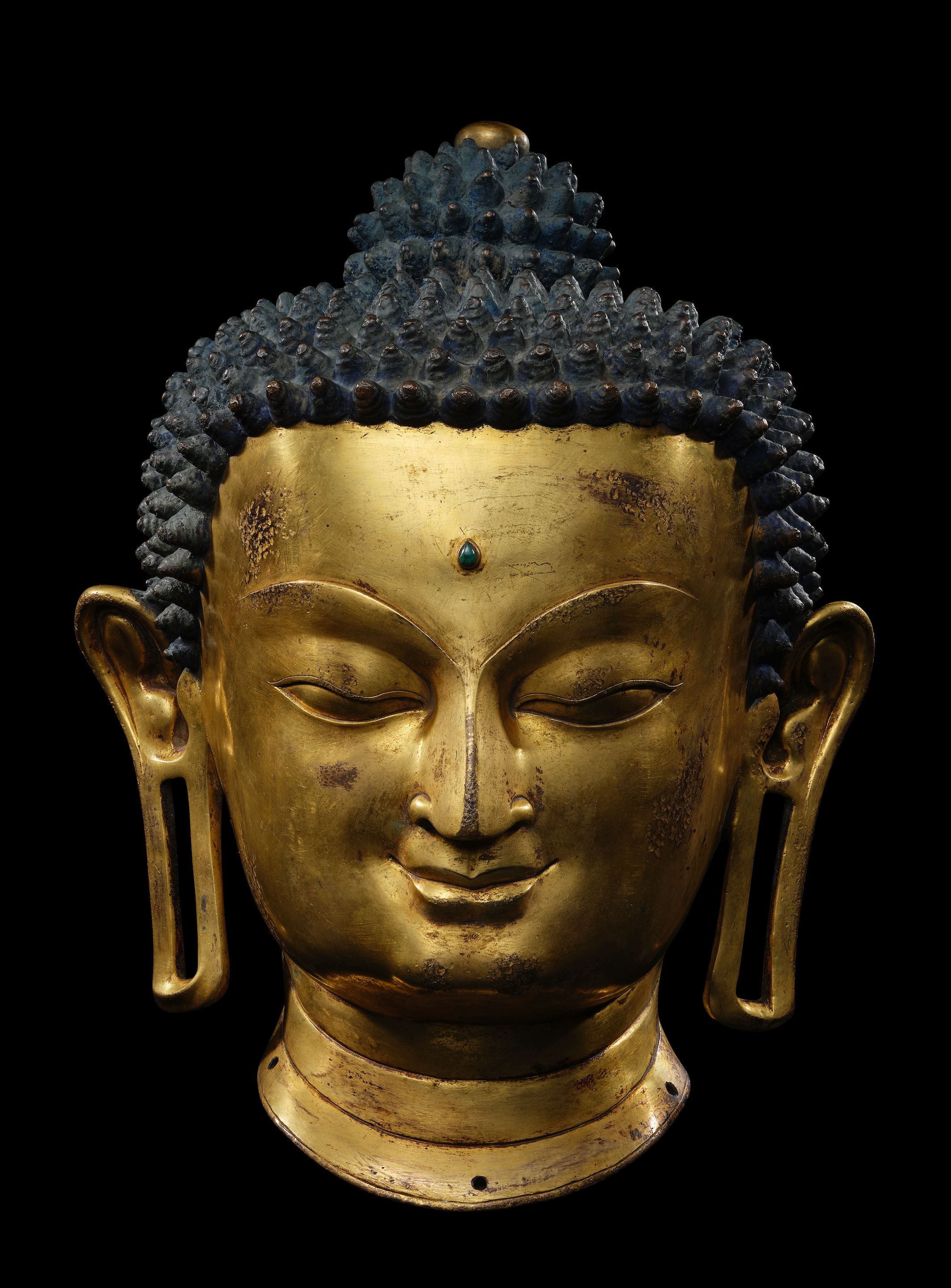
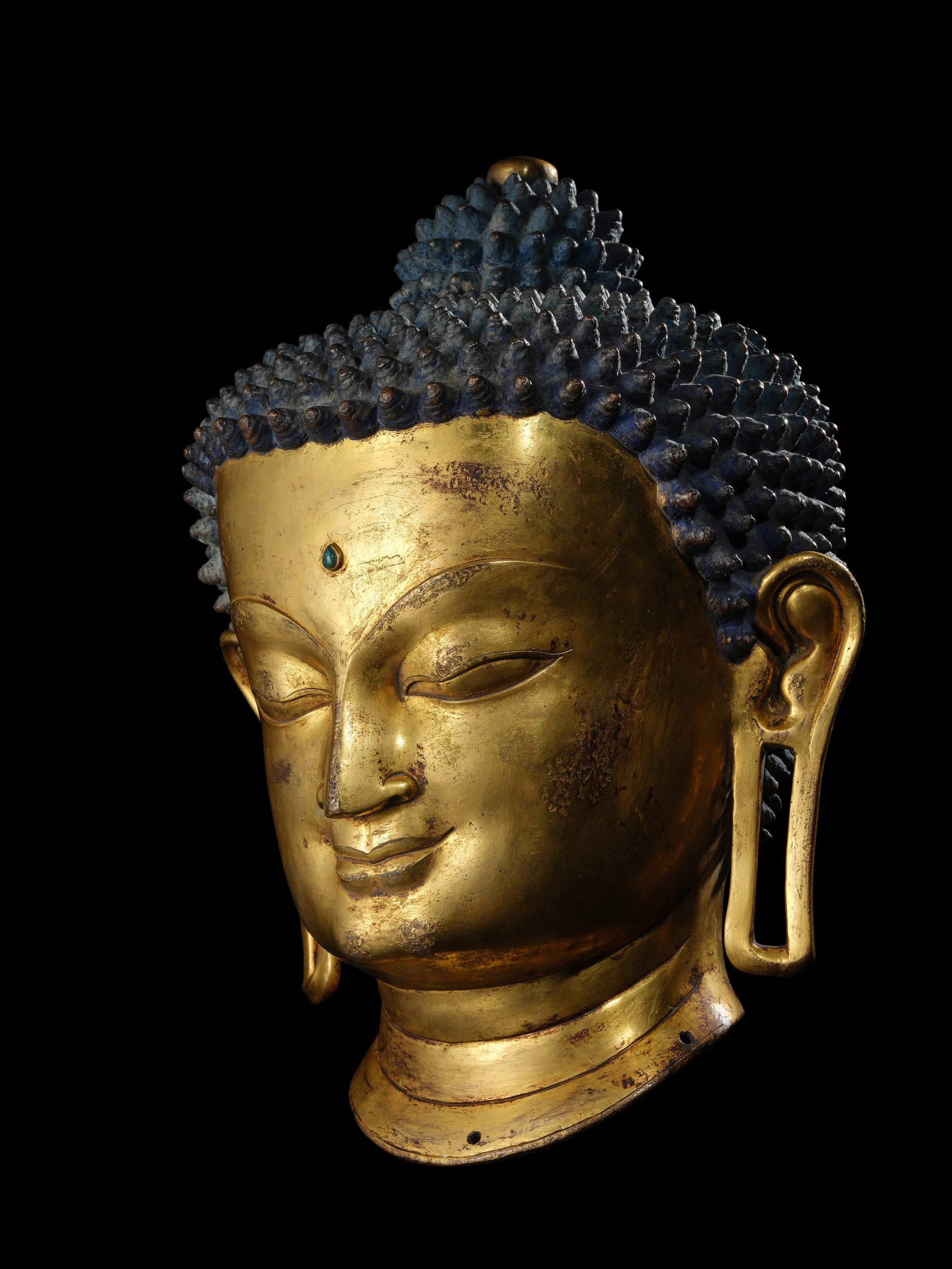
 A LARGE GILT COPPER ALLOY HEAD OF BUDDHA
NEPAL OR TIBET, 14TH CENTURY
With remains of blue pigment in the hair and an inset turquoise urna.
40.5 cm (26 in.) high
Footnotes
Provenance
Acquired in Hong Kong in 2008
Seventeen years in the Collection of Ulrich von Schroeder
尼泊爾或西藏 十四世紀 銅鎏金佛首
來源
2008年入藏於香港
烏爾里希·馮·施羅德珍藏,十七年
This large and important head was originally attached to a life-size statue of the historical Buddha Shakyamuni. The eyes cast slightly downward indicate it belonged to a seated Buddha. Whereas, a standing Buddha–of which only very few large ones had ever been cast in Tibet–would have its eyes directed towards the onlooker. As indicated by the blue pigment applied to the hair of the Buddha, there can be no doubt that the image to which this head belonged, was worshipped in Tibet.
As indicated by the style and the excellent technical properties, this Buddha image was most likely cast by a Newar master craftsman from Nepal. They were active in Tibet since the introduction of Buddhism there from around the 7th century, and played a crucial role in shaping the region's sculptural tradition. A broad forehead, tear‐drop urna, thinly curved upwardly sweeping eyebrows, and cupid's‐bow lips convey Nepalese physiognomy. The anatomical features are shared by other Buddha sculptures of the period, as exemplified by two bronzes sold at Bonhams, New York, 14 March 2016, lot 24, and 23 September 2020, lot 618, the former displaying similar tear-shaped urna and pointed curls. The present sculpture's exquisitely modelled, almost spikey curls are characteristic of large Buddha images before the 15th century, evinced by images photographed at Shalu monastery (fig. 1; von Schroeder, Buddhist Sculptures in Tibet, Vol. I, 2001 p. 516, pl. 169B). Compare also with several damaged 14th-century bronze statues photographed within Shalu monastery's storage in 1999 (Henss, The Cultural Monuments of Tibet, Vol. II, 2014 p. 585, fig. 830).
The 14th century in Tibet was marked by extensive monastic building programs. Large monumental sculptures were commissioned to be housed within these temples. Due to the scale, these sculptures were often cast in separate parts and joined together with pins and rivets, as exemplified here by the anchor points along the lower rim of the neck. Further intact, contemporaneous, large-scale gilt Nepalese sculptures cast in multiple parts are located within Shalu Monastery. These include a Maitreya made of five parts bearing Newar treatment in the prominent lower lip and broad forehead, and a Buddha Shakyamuni exhibiting a dual cast of head and body (fig. 2; von Schroeder, Buddhist Bronzes in Tibet, Vol. II, 2001, pl. 230C & pl. 231D; respectively).
页面工具
