
侧边栏

明代永乐宫廷铜鎏金金刚总持(香港苏富比)
尺寸:高21cm
年代:明代
质地:铜鎏金
风格:永乐宫廷
来源:拍卖会
成交:未成交(2014.12)
参阅:香港苏富比
鉴赏:

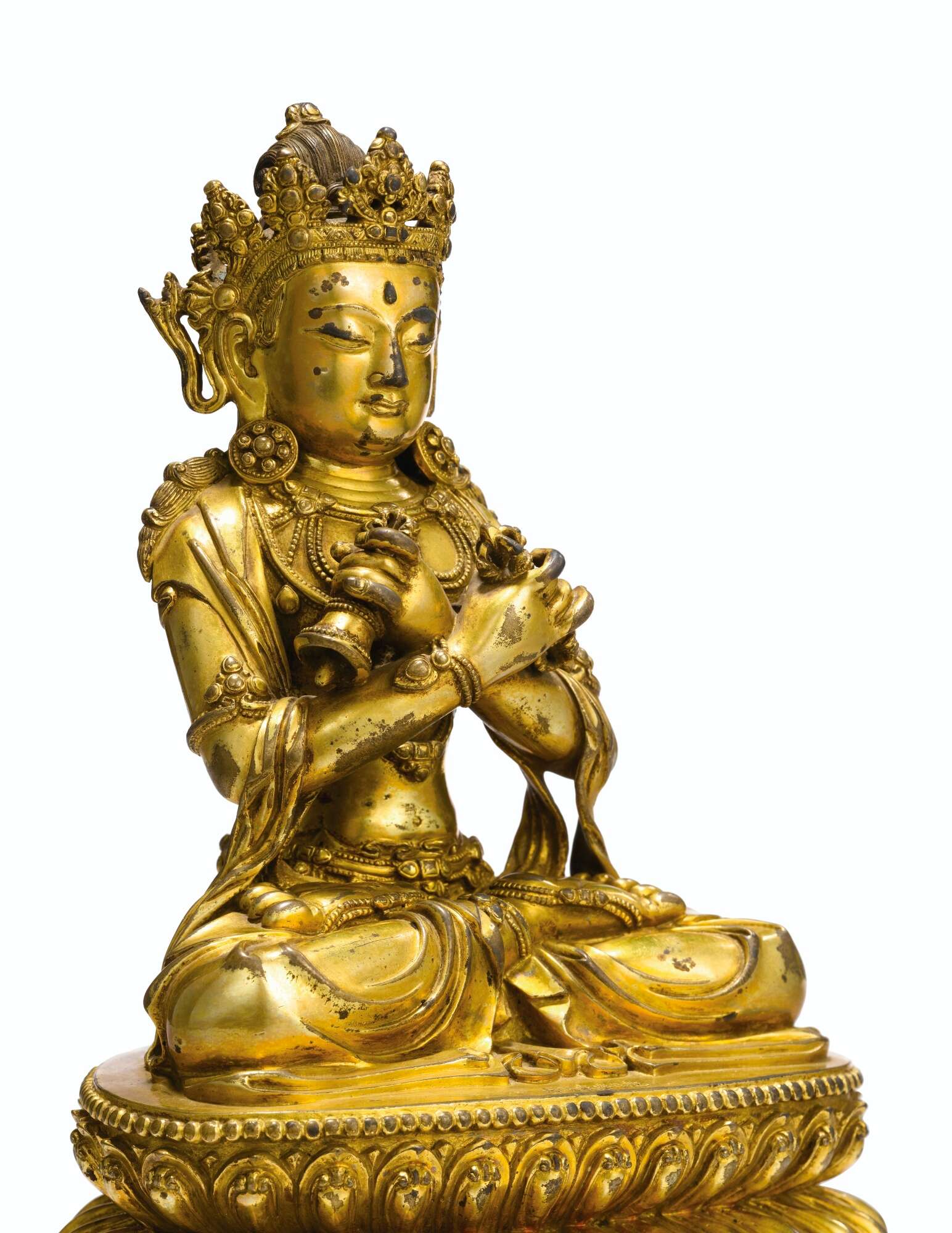
 A MAGNIFICENT AND EXTREMELY FINE GILT-BRONZE FIGURE OF VAJRADHARA
MARK AND PERIOD OF YONGLE
seated in vajraparyankasana, with both hands crossed in prajnalinganabhinayamudra clasping avajra and ghanta, wearing an eight leaf crown enclosing the high scrolling chignon set with acintamani finial, the meditative face with crisply cast features, framed by large wheel-shaped earrings, wearing extravagant beaded jewellery and belt, a dhoti and a scarf draped across the shoulders and off the arms, supported by a double lotus pedestal inscribed Da Ming Yongle nian shi, the base engraved with a visvavajra
21 cm., 8 1/4 in.
品相说明:
The piece is in excellent condition with only very minor occasional traces of wear to the original gilding on the extremities. The base plate is intact.
Provenance
The Speelman Collection.
Sotheby's Hong Kong, 7th October 2006, lot 811.
Catalogue Note
Vajradhara is considered to be the embodiment of all Buddhist Wisdom, the teacher of all Tantras. He is the Adi Buddha, Primordial Enlightened Being, related to the seminal teachings of the Sakya order and the Karma Kagyu order, two Tibetan Buddhist denominations that had significant influence in the court of Chengzu, the Yongle Emperor. Thus, fitting iconography for a sculpture perhaps intended as an imperial gift to a hierarch of either order. Official accounts, in particular the court record of daily events, Xizang shiliao, document numerous imperial gifts to Tibetan lamas, and to their temples and monasteries in the Chinese capital and Tibet. An entry in the Xizang shiliao on the eighth day of the fourth month of the female fire pig year, 1407, records that the emperor had a vision of his spiritual mentor the Fifth Karmapa, head of the Karma Kagyu order, Dezhin Shegpa (De), “….Chengzu sees the figure of De blazing like the sun, one span high … has an image made according to his vision and gives it to De …”, see Karmay, 1975, pp. 77-8. Tibetan religious leaders were often perceived as manifestions of deities, so the emperor’s vision of his religious mentor may well have been in the guise of say Vajradhara, the spiritual progenitor of Dezhin Shegpa’s Kagyu order, and his gift a gilt bronze very much like this one span high Vajradhara with the golden colour of the blazing sun. Four very similar Yongle period gilt bronzes of Vajradhara are recorded, all now in Tibetan monastery collections, illustrated by Ulrich, Buddhist Sculptures in Tibet, Hong Kong, 2001, von Schroeder, pp. 1250-1, pls. 343A-E.
金刚总持被视为一切佛教智慧的总集,是所有密续教法的导师。作为本初佛、原初觉者,他与萨迦派和噶玛噶举派的根本教法紧密相关,这两个藏传佛教宗派在永乐皇帝(明成祖)的宫廷中具有重要影响力。因此,此尊造像的图式非常适合作为皇家赠礼,或许旨在馈赠给其中一派的高僧。官方记载,特别是宫廷日常事件的记录《西藏史料》,详细记载了多次向西藏喇嘛以及他们在京师和西藏的寺庙、寺院赐赠的皇家礼物。
《西藏史料》中有一条记录,在阴火猪年(1407年)四月初八,记载皇帝在其精神导师、噶玛噶举派领袖第五世噶玛巴·得银协巴(Dezhin Shegpa)面前显圣:“……成祖见得上师(得银协巴)之身相,光明如日,高一尺……遂依此瑞相造像,并赐予上师……”,见Karmay, 1975, pp. 77-8。西藏的宗教领袖常被视为佛菩萨的化身,因此皇帝对其宗教导师的瑞相显圣,很可能就是以得银协巴所属噶举派的精神源头——金刚总持——的形象显现,而他所赐赠的鎏金铜像,很可能就非常类似这尊约一尺高、呈现烈日金光般的金刚总持造像。目前已知有四尊非常相似的永乐时期鎏金铜金刚总持造像,均藏于西藏寺院,刊载于乌尔里希·冯·施罗德《西藏佛教雕塑》(香港,2001年)第1250-1251页,图版343A-E。
页面工具
