
侧边栏

9世纪斯瓦特青铜大日如来坐像(纽约邦瀚斯)
尺寸:高17.8 cm
年代:9世纪
质地:青铜
风格:斯瓦特
来源:拍卖会
成交:未成交(2018.03)
参阅:纽约邦瀚斯
鉴赏:
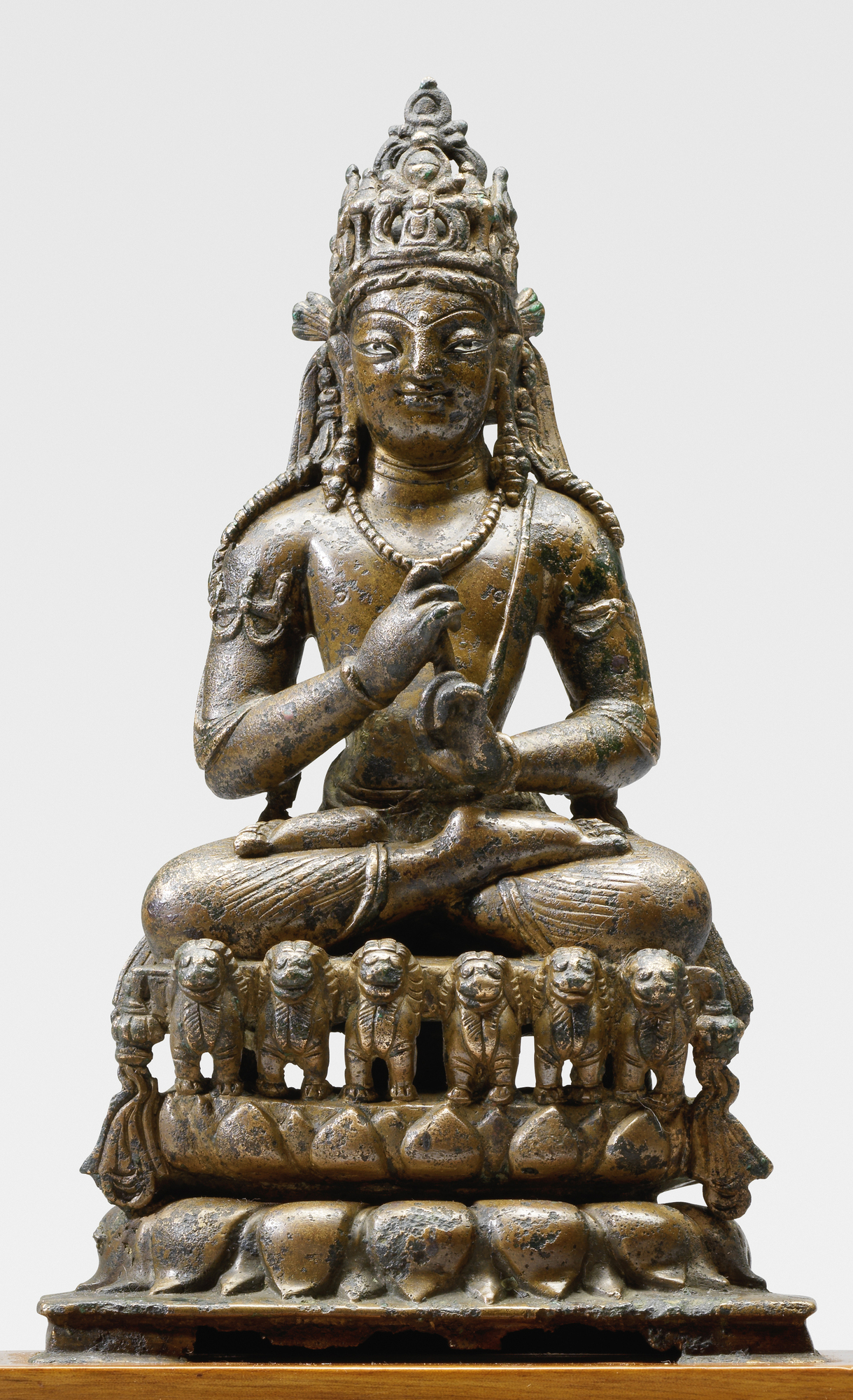 A SILVER INLAID COPPER ALLOY FIGURE OF VAIROCANA
SWAT VALLEY, 8TH/9TH CENTURY
Himalayan Art Resources item no.61576
7 in. (17.8 cm) high
Footnotes
斯瓦特 八/九世紀 錯銀毗盧遮那佛銅像
The Swat Valley served as an important repository for Buddhism after the Huns decimated the Kushan Empire in the 6th century, destroying many monasteries within the ancient region of Gandhara. Spanning the 7th to 10th centuries, the small corpus of Swat bronzes demonstrates an adaptive artistic tradition, responding to nearby regional styles such as Gandhara, Gupta, and Kashmir.
Akshobhya would eventually rise to prominence, but considerable evidence indicates that at the time of this sculpture's creation, Vairocana was the principal Cosmic Buddha worshipped in the Western Himalayas. The most telling corroboration of his importance is that Tabo monastery in the Spiti Valley, the oldest continuously operating enclave in the Himalayas since its foundation in 966, was constructed to house a sculptural mandala with Saravid Mahavairocana at its center (see Klimburg-Salter (ed.), Tabo, Milan, 1997, p.97, g.61).
The present sculpture is outstanding for the size and completeness of its composition. The casting's finer details are preserved in the delicate modeling of the thin scarf across Vairocana's arms, and the rich spiraling tresses framing his broad shoulders. Armbands high on the biceps show three prominent jewels above chained swags. Vairocana's plump cheeks and penetrating inset silver eyes complete the remarkable figure.
Six buoyant lions protect his throne. Sashes cascade on either side, adding movement to the frontal image. These combined elements are shared by a similar figure with four lions held in the Palace Museum, Beijing, published in Gugong bowuyuan cang: wenwu zhenpin quanji; 60: Zangchuan fojiao zaoxiang, Hong Kong, 2008, p.16, no.15.
The bronze also closely compares to a slightly smaller example sold by Bonhams, New York, 16 March 2015, lot 9, which shares the same crown, facial type, lions, and 'artichoke-form' lotus petals. See also the Maitreya in the British Museum, attributed to Swat Valley, 8th-9th century, published in Pal, Bronzes of Kashmir, New Delhi, 1975, pp.127 & 201, nos. 41 & 76.
A Swat bronze of Akshobhya also formerly belonging to the Wali Sahib of Swat is now in the Metropolitan Museum of Art, (acc.#1985.77; Menzies, Buddha: Radiant Awakening, Sydney, 2001, p. 96, no. 68).
Published
Douglas Barrett, 'Bronzes form Northwest India and Western Pakistan', in Lalit Kala Akademi, April, New Dehli, 1962, p.XXVI, fig.12.
Phyllis Granoff, 'A Portable Buddhist Shrine from Central Asia', in Archives of Asian Art, vol.22, 1968-9, p.86, fig.14.
Ulrich von Schroeder, Indo-Tibetan Bronzes, Hong Kong, 1981, p.94, no.11A.
Provenance
Collection of Wali Sahib of Swat before 1962
Private US Collection, 1970s
页面工具
