
侧边栏

16世纪明代万历(1573年)珐华彩瓷塑自在观音坐像(伦敦大英博物馆)
尺寸:高52.60 cm 重12.40 千克
年代:16世纪 明代万历 1573年
质地:珐华彩瓷塑
风格:中原 山西(Yangcheng)
来源:伦敦大英博物馆
参阅:外部链接
鉴赏:

 参考年代稍晚的一件:17世纪明代万历(1615年)福建漳州瓷塑自在观音坐像(旧金山亚洲艺术博物馆)
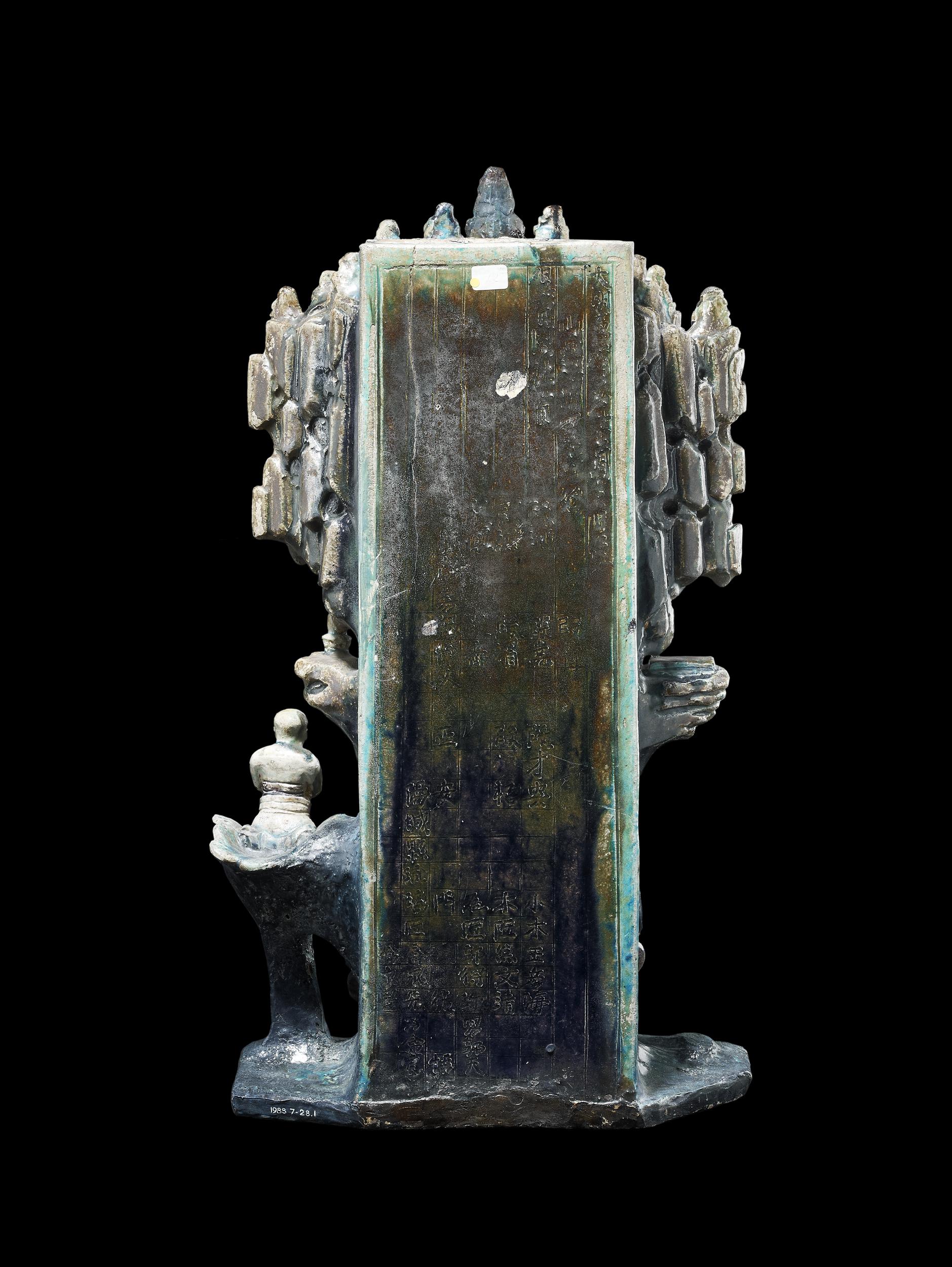
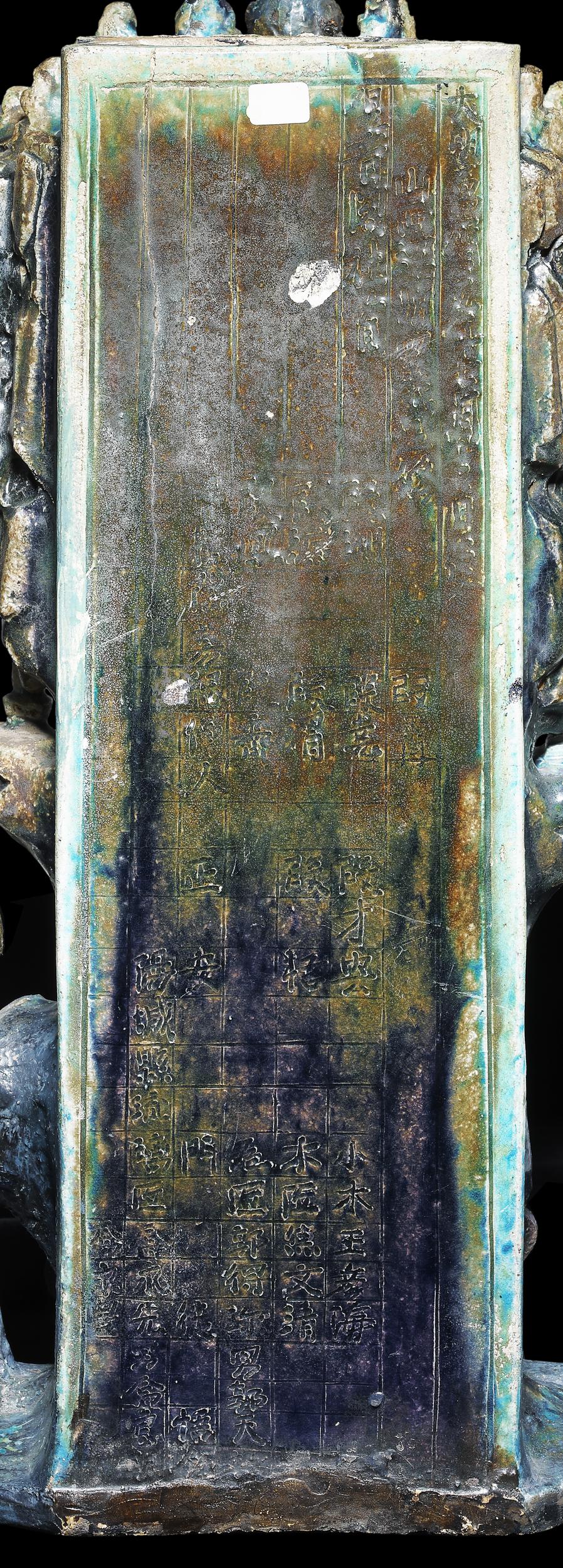
珐华彩佛龛式观音菩萨像建筑构件。此件作品具有极高的文献价值。作为建筑构件,其表现的是观音菩萨在莲花池的岩窟中,悠然坐于莲蓬之上。观音身着飘逸天衣,佩戴璎珞珠宝与宝冠。其旁有一赤膊弟子,双手合十,跪于莲叶之上。观音两侧的岩壁之上,分别陈列着她的法物:一为瓶中杨柳,一为经袱包裹的经卷。观音头顶的岩壁上,饰有三个圆形开光,内浮刻铭文,自右至左为“莲池会”三字。造像背部附有一中空的长方形插榫,约自下三分之一处开孔。背部表面刻有用于书写题记的网格线,并在分层施用的绿松石色与深蓝色釉下,阴刻有铭文。由于釉层几乎淹没了部分笔画,加之建筑构件底部经过修补,覆盖了最下一行字,导致此段题记难以辨识。
Architectural fitting in the form of the Bodhisattva Guanyin in a grotto with 'fahua'-palette glazes. This is a truly remarkable documentary piece. An architectural fitting, it represents the Bodhisattva Guanyin seated at ease on a lotus seed pod in a grotto in a lotus pond. She is dressed in flowing robes, jewellery and a crown. Beside her is a Buddhist disciple with bare torso and his hands held together in prayer, kneeling on a lotus leaf. On either side of Guanyin on rocky outcrops are her attributes: a willow branch in a vase and a sutra on a cloth. Above her head is an overhanging rock with three relief characters in roundels which read, from right to left: 'Lian chi hui' [Festival of the Lotus Pond]. Attached to the back of the sculpture is a hollow rectangular tube which is pierced through about one third of the way down. The back is scored with a grid of guide lines for calligraphy and is incised beneath a layered turquoise and dark blue glaze. This inscription is hard to decipher as the glaze has almost obscured certain characters and the architectural fitting is repaired around the base, concealing some of the bottom line of characters.
铭文:
Inscription position: roundels
Inscription language: Chinese
Inscription content: 蓮池會
Inscription transliteration: Lian chi hui
Inscription translation: Festival of the Lotus Pond
Inscription note: Three relief characters in roundels.
Inscription type: inscription
Inscription position: Back
Inscription language: Chinese
Inscription script: Clerical
Inscription content: 大明萬曆元年七月吉日造陝西河州
Inscription transliteration: Da Ming Wanli yuan nian qi yue jiri zao Shanxi Hezhou □ □ □ □ Guanyin ge she yi jian Xia □ Xia □ Xia □ Xia Xiao Xia Liang Xia Wei Xia Qi Xia Caixing Xia Wu Xiaomu Wang Yanhai, mujiang Jiao Wenqing, nijiang Guo Deyin nan Guo Tianmen Yangcheng xian muyuan sengren Zheng'an men De Wu □ Yangcheng xian liuli jiang Qiao Yongxian nan Qiao Hui □ He Jia zao
Inscription translation: One item (made to be presented to) the Guanyin Pavilion in (place name) in Hezhou, in Shanxi province, on an auspicious day of the seventh month of the first year of the Great Ming Wanli reign (AD 1573) Mr Xia n, Mr Xia n, Mr Xia □ Mr Xia Xiao, Mr Xia Liang, Mr Xia Wei, Mr Xia Qi Mr Xia Caixing and Mr Xia Wu Carver Wang Yanhui, carpenter Jiao Wenqing, master potter Guo Deyin and son Guo Tianmen The donations were solicited by the Buddhist Priest De Wu from the Gate of Perfect Peace (Zheng'an men) in Yangcheng county The glazers are Qiao Yongxian and his son Qiao Hui n from Yangcheng county Family workshop
铭文类型:题记
铭文位置:背部
铭文语种:中文
铭文书体:隶书
铭文内容:大明萬曆元年七月吉日造陝西河州□□□□觀音閣捨壹間下□下□下□□下孝下良下威下琦下□下蔡興下武下木匠王延海木匠焦文清□匠郭德□男郭天門陽城縣募緣僧人正庵門德悟□□陽城縣琉璃匠喬永顯男喬惠□賀家造
铭文转写:Da Ming Wanli yuan nian qi yue jiri zao Shanxi Hezhou □ □ □ □ Guanyin ge she yi jian Xia □ Xia □ Xia □ Xia Xiao Xia Liang Xia Wei Xia Qi Xia Caixing Xia Wu, mujiang Wang Yanhai, mujiang Jiao Wenqing, ?jiang Guo Deyin nan Guo Tianmen, Yangcheng xian muyuan sengren Zheng'an men De Wu, □ □ Yangcheng xian liuli jiang Qiao Yongxian nan Qiao Hui □, He Jia zao
铭文翻译:大明万历元年(1573年)七月吉日,造于陕西河州(今甘肃省临夏回族自治州)……观音阁施舍一间。下□、下□、下□、下孝、下良、下威、下琦、下□、下蔡兴、下武。木匠王延海,木匠焦文清,□匠郭德印及其子郭天门。阳城县募缘僧人正庵门德悟。□□阳城县琉璃匠乔永显及其子乔惠□。贺家造。
铭文说明:铭文右上角记录了制作和安置的日期与地点。其后是一连串以“下”为姓、跨越三代的男性族人名字,按辈分长幼清晰排列。首先为家族中三位长辈。其次为四位中年辈成员。最后为两位最年轻的晚辈。这些名字下方,镌刻着参与制作此尊瓷塑像的各工种匠人姓名。接着记录了为此像化缘募资的僧人。最后列出此件的琉璃匠人。
策展人评论
Harrison-Hall 2001:
此件题记为探究晚明时期佛教造像的定制与生产方式提供了引人入胜的视角。与本图录中许多为皇宫、皇陵或佛寺烧造的琉璃构件不同,这件建筑构件是为一座观音寺制作的,位于今山西省,并由整个下氏家族供奉。
晚明时期,寺院会在士绅阶层中发起募捐活动。寺院需要持续的资金来修缮建筑,以吸引访客和未来的布施。由此掀起了一股由士绅赞助的建造热潮,其规模仅次于10世纪由帝王支持的建造活动。这些有文化的施主既期望获得现世回报,如未来的财富和社会地位,也关心自身的精神福祉,可能还包含着赎罪和履行家族责任的想法。题记中出现连续几代施主的名字,表明了这是一个长期性的宗族活动。
旧金山亚洲艺术博物馆藏有一件年代稍晚的明代三彩建筑构件,其上浮雕着阿弥陀佛禅定像与二胁侍菩萨。该件铭文纪年为“万历四十六年”(1615年),同样由阳城县的乔氏后代、匠人乔永丰及其子乔长正、乔长元在通济村制作。
Curator's comments
Harrison-Hall 2001:
The inscription provides a fascinating insight into the commissioning and production of votive images in the late Ming period. Unlike many of the tiles in the present catalogue, which were made for imperial palaces, imperial tombs or Buddhist temples, this architectural fitting was made for a Guanyin temple. The temple was situated in modern Shanxi province, and was presented as an offering by the whole of the Xia family.
In the late Ming period, fund-raising appeals were launched by monasteries among the gentry. Monasteries were in perpetual need of funds to carry out repairs to buildings, to attract visitors and future donations. There ensued a building boom, sponsored by the gentry, which was second only to that supported by emperors in the tenth century. These literate donors sought earthly gains such as future fortune and social standing, but were also concerned with their spiritual welfare, perhaps atonement for past sins and a regard for the performance of family duties. The names of successive generations within a family of benefactors indicates long-term lineage activity.
A later 'sancai' architectural fitting, decorated in relief with Amitabha sitting in meditative posture accompanied by two bodhisattvas, is in the Asian Art Museum, San Francisco. It is dated 'forty-sixth year of the Wanli period' (1615) and was similarly made in Yangcheng by later generations of the Qiao family, craftsman Qiao Yongfeng and his sons Qiao Changzheng and Qiao Changyuan, but in Tongji village.
Inscription note: The date and place of manufacture and installation are recorded in the top right-hand corner of the inscription. This is followed by the names of three generations of men from the same family with the surname Xia, starting with the oldest and ending with the youngest, clearly separated in their age groups. First, three older members of the family. Then four members of the middle generation and finally two members of the youngest generation. Below these names are inscribed those of the craftsmen involved in the production of the ceramic figure. Next the priest who asked for subscriptions to make the figure is recorded. The glazers of the piece are next noted.
著录:
Harrison-Hall 2001 / Catalogue of Late Yuan and Ming Ceramics in the British Museum (18:23)
展览:
2007 8 Feb-5 Aug, BM Gallery 91, 'Gods, Guardians and Immortals: Chinese Religious Paintings'
2012 22 Jun-2013 6 Jan, Beijing, National Museum of China, ‘Passion for Porcelain’
来源:
Purchased from: Spink & Son Ltd, 1988年
页面工具
