
侧边栏

6-7世纪印度笈多风格黄铜释迦牟尼佛立像(香港邦瀚斯)
尺寸:H. 26 cm
年代:6世纪末-7世纪初(Gupta period)
质地:黄铜
风格:印度 笈多
来源:拍卖会
成交:17,152,000港元(2024.11)
参阅:外部链接
鉴赏:

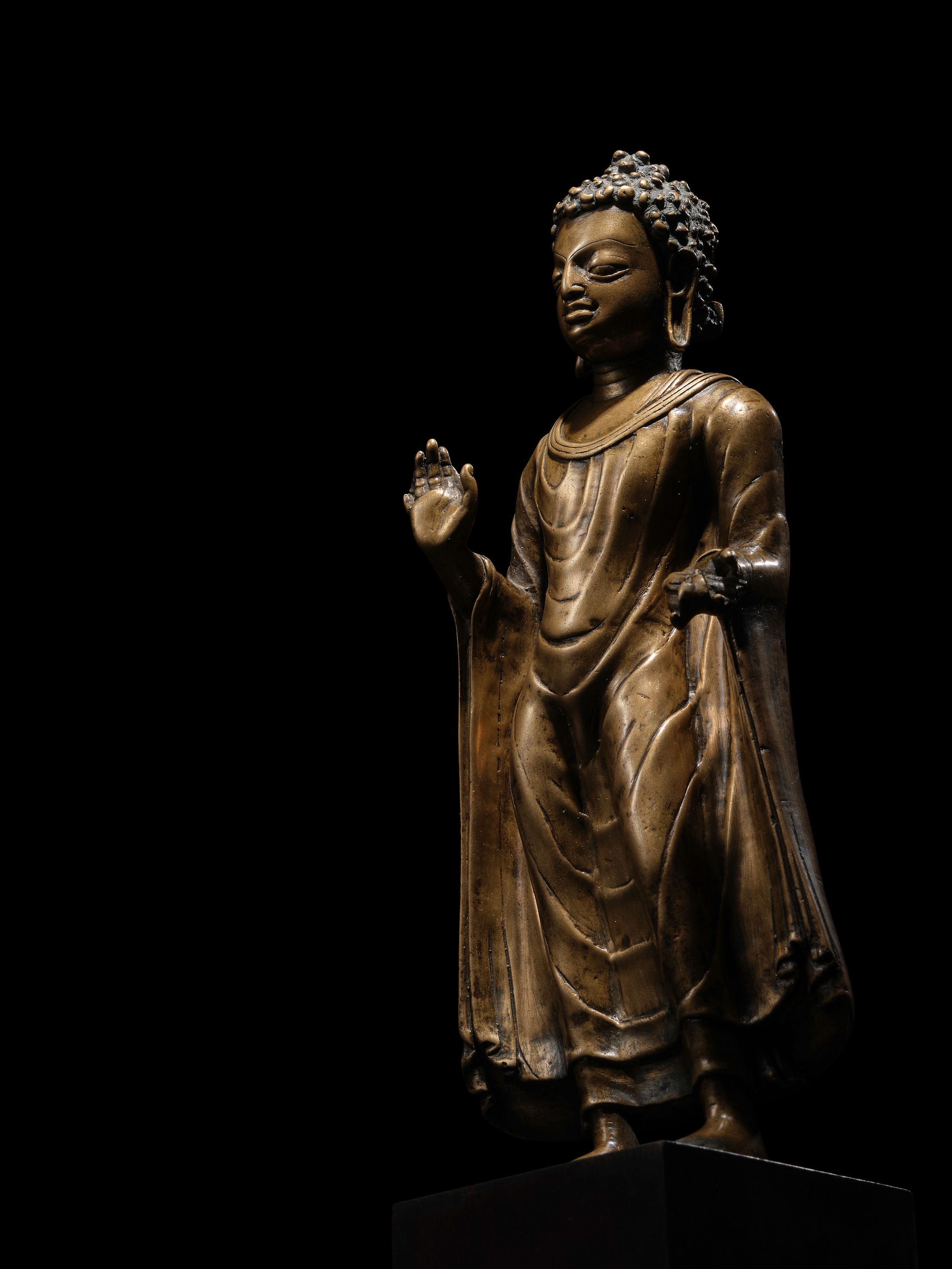
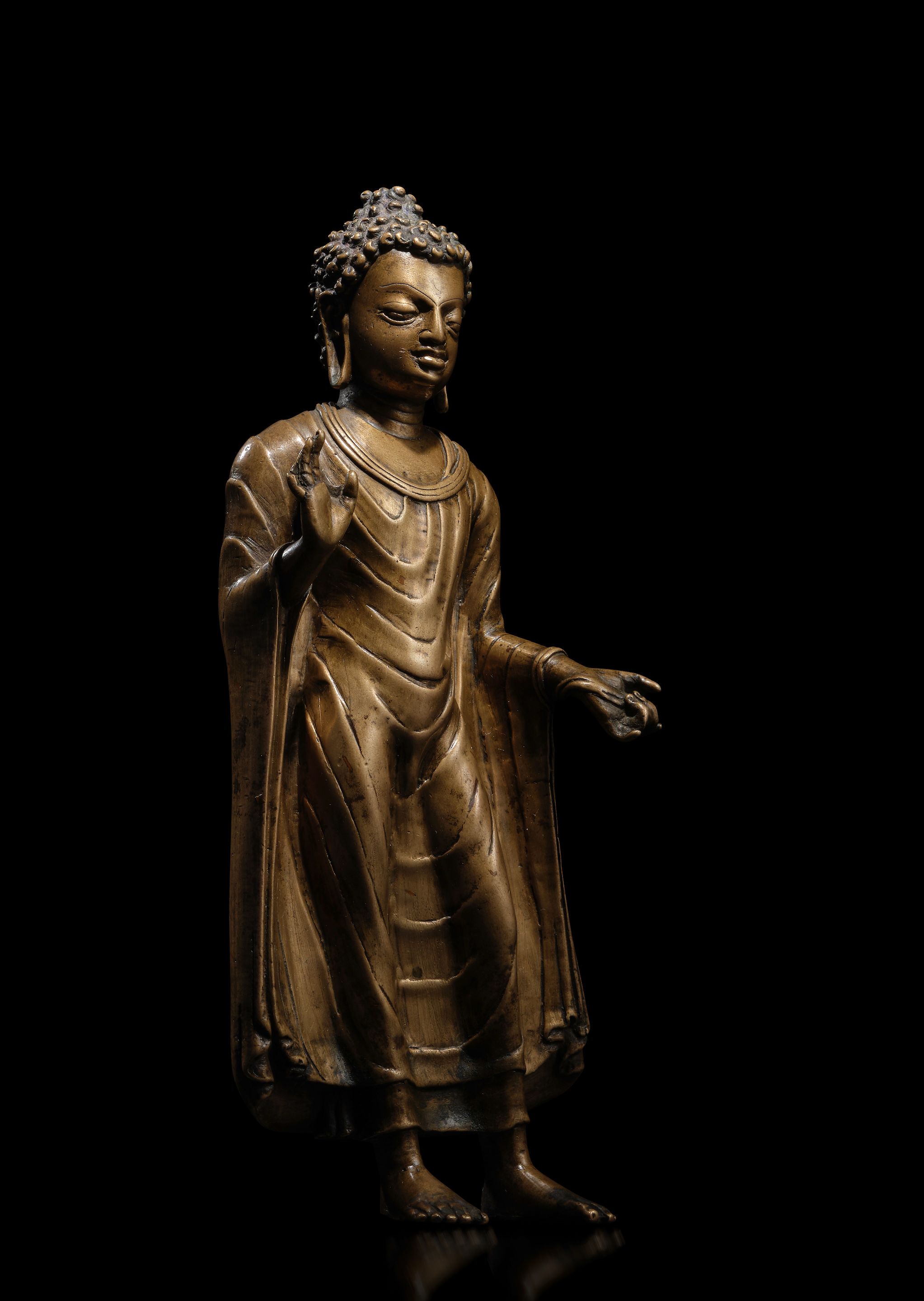
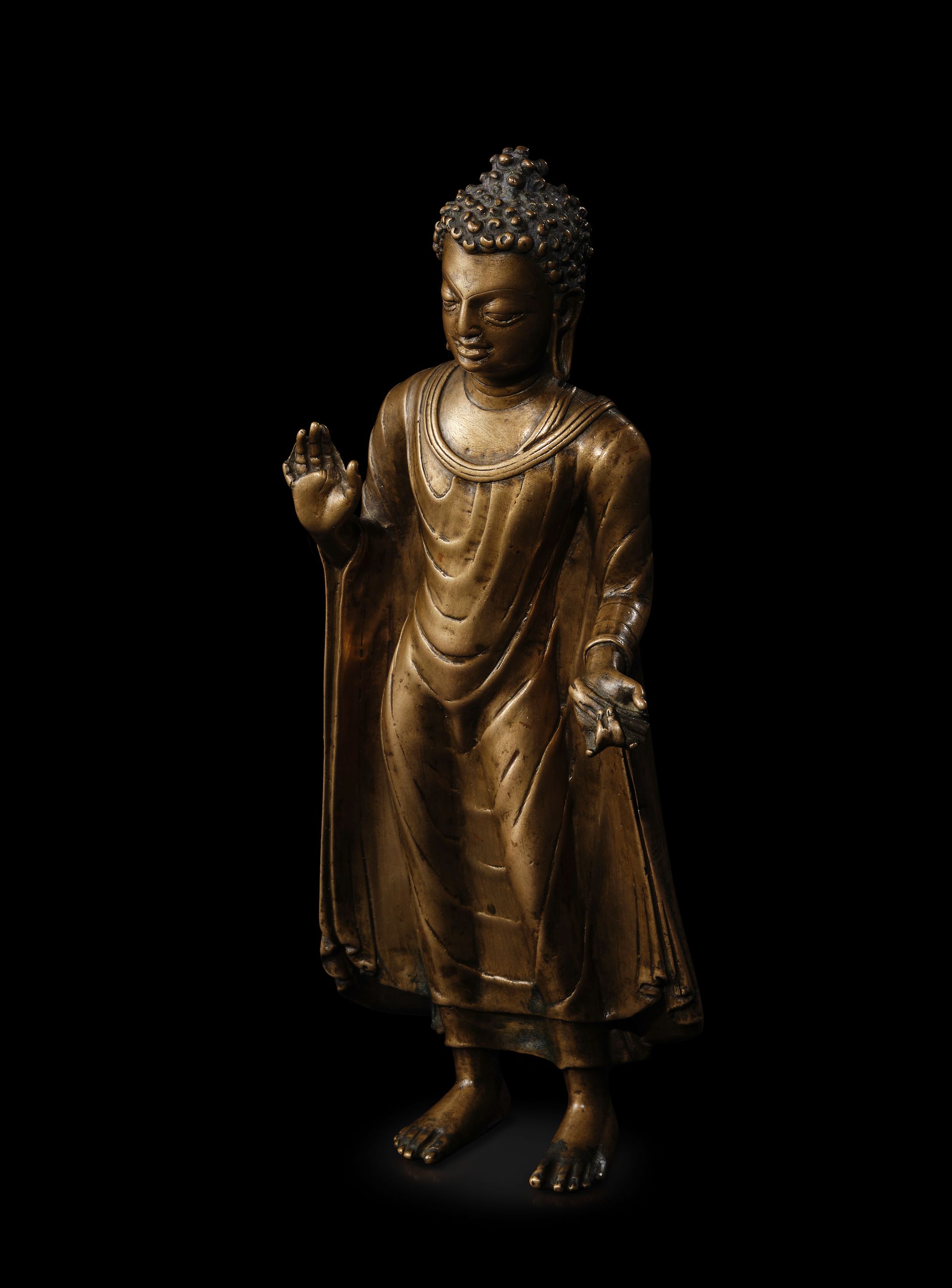 A BRASS FIGURE OF BUDDHA SHAKYAMUNI
NORTH INDIA, GUPTA PERIOD, LATE 6TH/EARLY 7TH CENTURY
Himalayan Art Resources item no. 32771
26 cm (10 1/4 in.) high
Footnotes
印度北部 笈多時期 六世紀晚期/七世紀早期 釋迦牟尼銅像
Published
Yixi (ed.), The Art of Buddhist Sculpture, Beijing, 2013, p. 64.
Exhibited
The Art of Buddhist Sculpture, Capital Museum, Beijing, 8-28 November 2013
Provenance
Karen Beagle Collection, UK (1957-2021)
Classic examples of standing Buddha images relaxed in posture and gesturing in reassurance while holding the draping ends of his robes, as seen here, reveal a Gupta archetype. The form shows an aesthetic which unifies earlier modalities of the Kushana period from the Classical treatment of drapery of the Gandharan types with the strong physicality of Mathuran types. Unlike the strict adherence to weighted drapery of the Classical types, Gupta styles emphasize transparency and weightlessness of fabric. Unlike the monumentality and thick limbed stiffness of Mathuran figures, Guptan modeling articulates slender contours of the body. Two streams dominate the early aesthetics of the Gupta period, one coming from Mathura in the western part of Uttar Pradesh and the other located in the eastern part coming from Sarnath. Of these two types, this model shows a combination of both schools, which developed into a strong tradition of metal casting in the northeastern region of Bihar. The type became the quintessential standing Buddha image as Buddhism spread throughout India, Nepal, Tibet, and further East.
Cast in the later phase of the Gupta period, this sculpture shows the full development of the dynamic figurative form evolving from Sarnath. Examples of this type held in several major museums, all show the figure in abhanga, a posture with one knee bent and the opposite hip extended to the side (cf., Victoria & Albert Museum, IS.3-2004; Los Angeles County Museum of Art, M.70.17, Fig. 1; The Metropolitan Museum of Art, 69.222). Earlier forms from Sarnath of the 5th century (Huntington, The Art of Ancient India, 1985, p. 202, no. 10.19) show precedents for the same posture, although they retain a more limited range of motion, more closely linked the Kushana-Mathura models. The full expression here, with hands in counterbalance to the S-shaped curve, articulates diagonal movements across the body, lending itself to the gentle sway. This is further induced by two other juxtaposing elements between the drapery and the translucence of the entire body below the robes. Early Sarnath images like the Huntington example highlight the full transparency of the robe, indicating only the collar and outlining hems of the draping robes. This image retains the folded drapery more typical of northwestern idioms in the wide U-shaped across the body, though they show little density aside from the pleated edges along each of the lower corners. The facial features change little though from their earlier models, with the large arched eyebrows sweeping across heavy lidded eyes and a wide-tipped nose spreading above full but narrow lips.
The first half of the 7th century in particular, following the collapse of the Gupta empire, saw a continued expansion of Buddhism throughout the northeastern part of India. Under the rulership of King Harsha (r. 606-47), a devout Buddhist, patronage was offered towards the building of monasteries in and around Nalanda, located in Bihar. Artistic production in Bihar, as documented by the Chinese monk and pilgrim, Xuanzang (602-64), was contingent on the commissioning of sculptures for the Buddhist monasteries. In comparing this sculpture to the LACMA and Met examples and another published in von Schroeder, Indo-Tibetan Bronzes, 1981, p. 216, no. 45C, all show parallels in their balance between Sarnath types and Mathura style drapery, suggesting a regional tradition of casting. Also like the LACMA and Met examples, this sculpture has an unfinished back and a tang positioned behind the head indicating that each figure once had a nimbus affixed to the back. Derivatives of the Mathuran and Sarnath sculptures of the earlier Gupta period, it is these portable images which carried this hallmark style out of India, becoming one of the most widely copied prototypes of the Buddha.
Its legacy is vividly recorded within Nepalese casting traditions, which have resemblance to Bihar standing Buddha images. The basic format is replicated in a contemporaneous 7th-century work from Nepal (ibid, p. 307, no. 75F), suggesting that the exchange of these images occurred alongside their production. The large-styled curls, the broad lidded eyes, plump lips, abstracted folds of the robe, wide framed robe translucently draping over the softly contoured body of a 9th-century sculpture (ibid, p. 309, no. 76E) not only show clear imitations of this style, but also vividly capture the graceful contours and reflective demeanor of Gupta art.
页面工具
